Most UK home offices are not really offices. They are box rooms, alcoves, the strip of floor beside a chimney breast, or a corner of a spare bedroom that still has to host guests twice a year. That reality should shape the standing desk versus fixed desk decision far more than any trend does. Both designs work well — they just fail in different ways, and usually for reasons you can measure before you spend anything.
Measure the Room Before You Compare Desks
Start with three numbers: usable width, usable depth and ceiling height. In a typical box room of around 2.4m by 2.4m, a 140cm desk leaves roughly a metre of wall, and that is before you account for the clearance a chair needs to slide back and for a door to open. Fixed desks are usually the better fit here simply because they can be shallower — 60cm deep rather than the 70–80cm many sit-stand frames need for stability.
Ceiling height matters more than people expect. When a sit-stand desk is raised for standing work, the desktop sits somewhere around waist-to-lower-rib height, and your monitor goes up from there. In a loft conversion with a sloped ceiling, or under a low window reveal, that extra 40cm can put the screen into the plaster. Measure your standing eye level, add the height of your monitor on its stand, and check it clears.
Two smaller things worth checking while you have the tape out: whether there is a socket within reach of where the desk will travel, and whether the power and monitor cables have enough slack to move through the full height range without snagging. A cable that runs tight at 110cm will pull, trip the anti-collision sensor, or simply unplug itself.
What a Standing Desk Actually Gives You
The honest benefit is variety. You can take a call on your feet, stretch out a stiff afternoon, and shift position without leaving the desk. Claims about sitting being uniquely dangerous are often oversold; the useful part is changing posture and moving more often than you otherwise would, not standing as a permanent state.
Standing all day brings its own complaints — tired feet, tight calves, an aching lower back. A workable pattern for most people is to sit for focused typing and stand for calls, reading or anything you would otherwise do leaning back. If you have an existing back, hip or circulation problem, speak to your GP or a physiotherapist about what suits you before you change how you work, and build up standing time gradually rather than switching cold.
One practical point: a standing desk is only comfortable if it is set correctly. Elbows roughly level with the desktop when you sit, and when standing, the desk high enough that your arms hang naturally. A footrest or anti-fatigue mat helps if you are on a hard floor.
Where a Fixed Desk Still Wins
A fixed desk does not wobble. If you write by hand, use a drawing board, or run two large monitors on a single arm, that solidity is worth a lot. It is also cheaper for the same surface area, which means the money you save can go towards a genuinely good chair — usually the better investment for comfort over a long day.
Fixed desks are quieter, need no power, and have no motor to fail in year four. They suit rooms that do double duty: a desk that looks like furniture is easier to live with in a guest room than a frame with a control panel. If you want a big surface — for sewing, model-making, or a record deck alongside a laptop — a plain table-style desk gives you far more area per pound.
Cost, Assembly and Long-Term Ownership
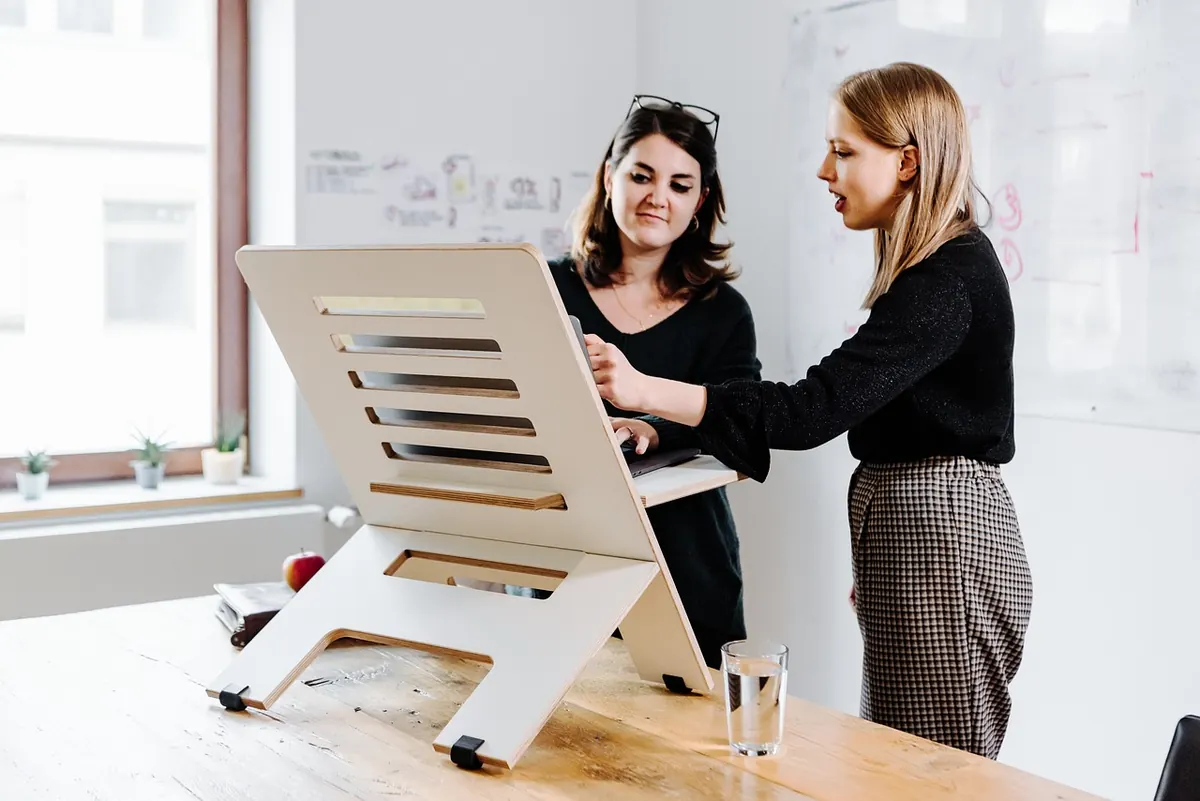
Sit-stand desks cost more than a fixed desk of similar size, because you are paying for a frame, a motor, a controller and a warranty. Before committing to a full desk, a sit-stand converter that sits on your existing desk is a cheap way to test whether you actually raise it. So is buying a sit-stand frame and fitting your own top, which lets you reuse a worktop you already like.
When you compare models, check these rather than the marketing copy:
- Height range — it must include both your seated and standing heights, which matters if you are notably short or tall.
- Weight capacity — add up monitors, arm, PC, speakers and anything else living up there.
- Stability at full height — desks that feel fine at 75cm can sway noticeably at 115cm.
- Motor warranty — the part most likely to fail, and worth checking the length carefully.
- Presets and anti-collision — small features that make a real difference day to day.
Also think about delivery and assembly. A solid dual-motor frame in a flat pack is heavy, and getting it up two flights of stairs in a Victorian terrace is a job in itself. Budget an hour or two for assembly, and recruit help.
If Space Is Tight
You do not have to choose between a full standing desk and nothing. A converter on a fixed desk gives you a standing option in seconds and folds away when you want the surface back. A wall-mounted folding desk frees the floor entirely in a hallway or landing. Narrow sit-stand frames and corner versions exist for awkward alcoves, and castors let a desk tuck against the wall when the room reverts to a bedroom.
How to Choose in Five Questions
- How long do you sit? Four hours a week of admin needs less flexibility than eight-hour days.
- What fits? Width, depth, ceiling clearance and chair space — measure before you browse.
- What sits on the desk? Heavy dual-monitor setups push you towards a sturdier frame or a fixed desk.
- Does the room do another job? If guests sleep there, a fixed desk that reads as furniture is often the kinder choice.
- Will you honestly raise it? If the answer is "probably not", put the difference into your chair.
A Sensible Default
If you work most of the day from home, have the floor space, and the height range suits you, a sit-stand desk is the more flexible purchase and will hold its usefulness as your working habits change. If the room is small, the budget is tight, or the desk has to look like furniture, a fixed desk with a converter on top is a perfectly good answer — and often the one people keep using after the novelty wears off.
Whichever way you go, sort the chair and the screen height first. Those two decisions affect your comfort more than whether the desk moves, and they are cheaper to change later.
Photo: Standsome / Pixabay